
With the growing adoption of smart home technology and increasing demand for high-end architectural decoration, the market for LED smart bathroom mirrors, anti-glare art mirrors, and customized decorative mirrors is expanding rapidly. However, during mirror sandblasting, downstream processors often face problems such as low backing-coating removal efficiency, glass edge chipping and breakage, uneven light transmission, excessively rough blasted surfaces, and iron contamination.
As a supplier of surface treatment and abrasive solutions, this article provides a systematic analysis of the key applications of mirror sandblasting—back-side coating removal for light transmission and front-side artistic frosting—covering abrasive material selection, grit-size matching, blasting pressure, and nozzle selection to help processors improve production efficiency and finished-product yield.
1. Core Applications and Process Principles
Mirror sandblasting is a surface treatment process that uses compressed air to propel abrasives such as Brown Fused Alumina, White Fused Alumina, or glass beads at high velocity onto the front or back surface of a mirror, thereby modifying its optical and surface characteristics.
Depending on the processing surface and desired result, mirror sandblasting can generally be divided into two major applications:
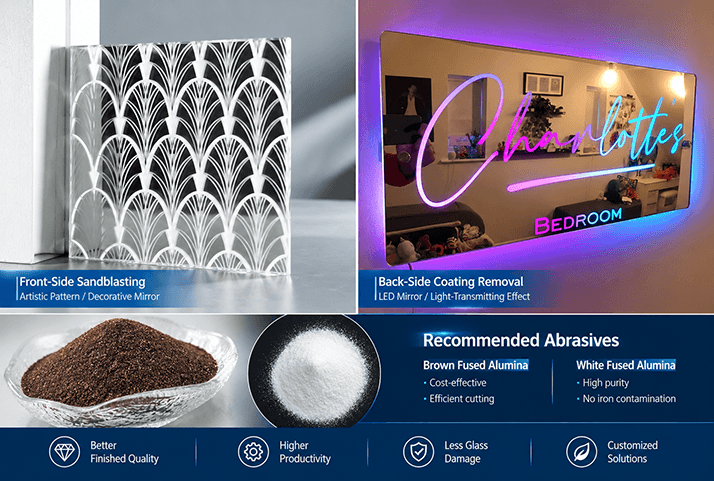
1.1 Back-Side Sandblasting / Coating Removal for LED Smart Mirrors
Process principle: Abrasive blasting is used to remove the silver resin paint layer and reflective silver layer from the back of the mirror, exposing the transparent glass substrate.
Main applications: This process is used to create light-transmitting areas such as LED light channels, touch-control icons, and display windows in smart bathroom mirrors. When LED strips are installed behind the mirror, light can pass through the blasted areas, creating a soft and uniform light-transmitting effect.
1.2 Front-Side Frosting for Art, Anti-Glare and Decorative Mirrors
Process principle: A stencil or engraving film is used to protect the areas that do not require processing, while abrasive is directly blasted onto the front surface of the glass to create a microscopic roughened surface with diffuse reflection.
Main applications: This process can be used to create patterns, logos, anti-glare effects, and fingerprint-resistant matte surfaces with a refined tactile finish.
2. Abrasive Material Selection: Balancing Quality and Cost Performance
Different mirror sandblasting applications have significantly different requirements for abrasive hardness, purity, and cutting performance.
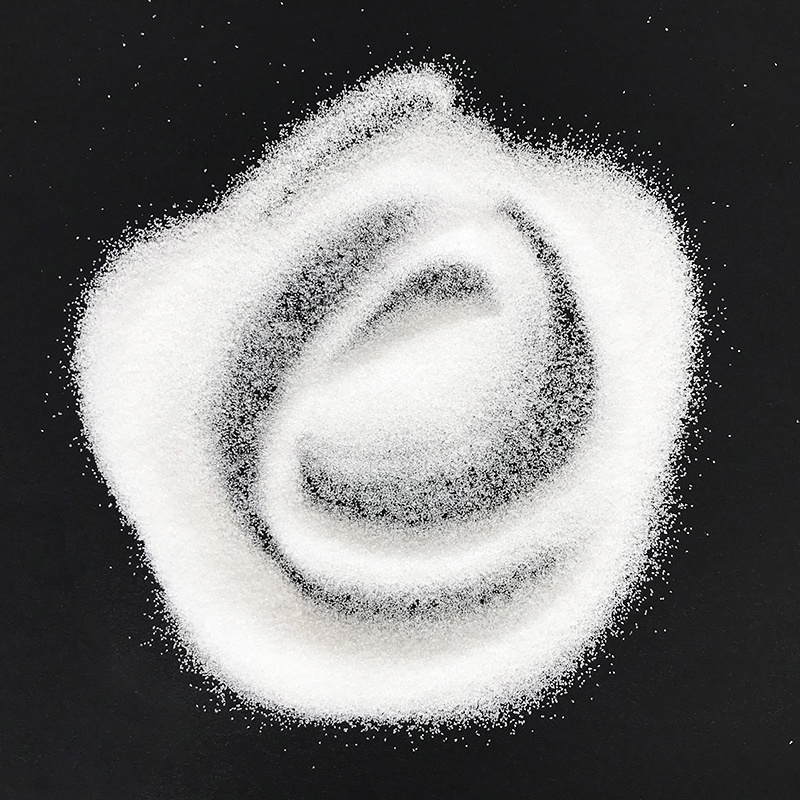
White Fused Alumina (WA — White Aluminum Oxide)
Characteristics: High aluminum oxide content (>99%), high hardness, strong cutting ability, good self-sharpening properties, and high cleanliness with minimal iron contamination.
Suitable applications: High-end LED smart mirror back-side coating removal and high-clarity front-side decorative frosting. Because it minimizes iron contamination and the risk of discoloration, it is a preferred abrasive for applications requiring high-quality light transmission and a clean, uniform matte surface.
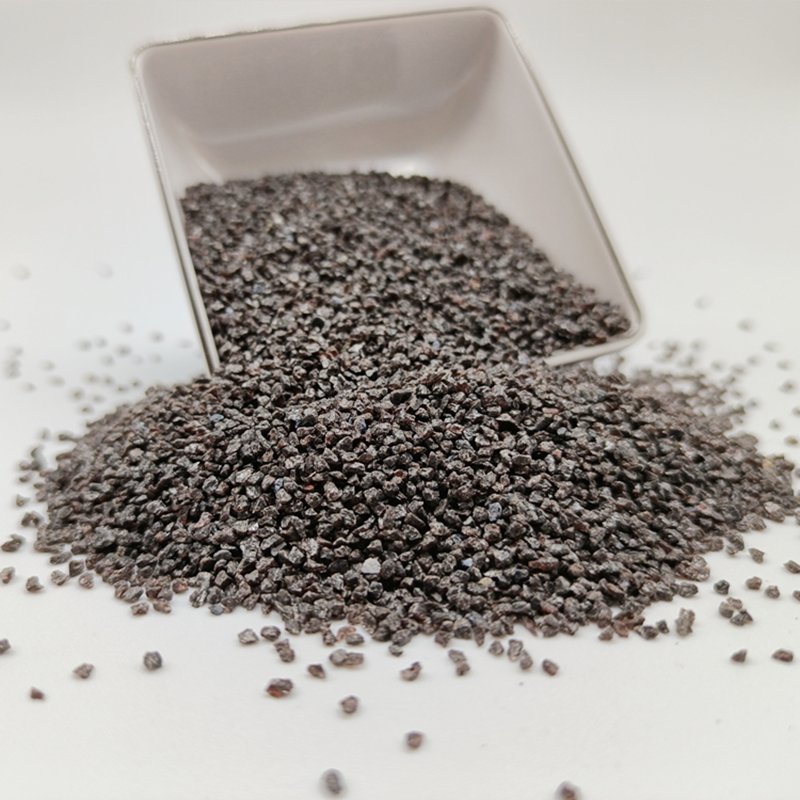
Brown Fused Alumina (A — Brown Aluminum Oxide)
Characteristics: Cost-effective, relatively high toughness, and efficient cutting performance.
Suitable applications: Rapid removal of silver paint and primer from the back of conventional mirrors in applications where cost efficiency is important. For high-end mirror processing, attention should be paid to the potential impact of trace impurities.
3. Grit Size, Pressure and Nozzle Selection Matrix
| Requirement | Abrasive | Grit Size | Pressure | Nozzle |
|---|---|---|---|---|
| LED back-side removal | White/Brown Fused Alumina | 120#–180# | 0.30–0.45 MPa | Boron Carbide, 6-8mm |
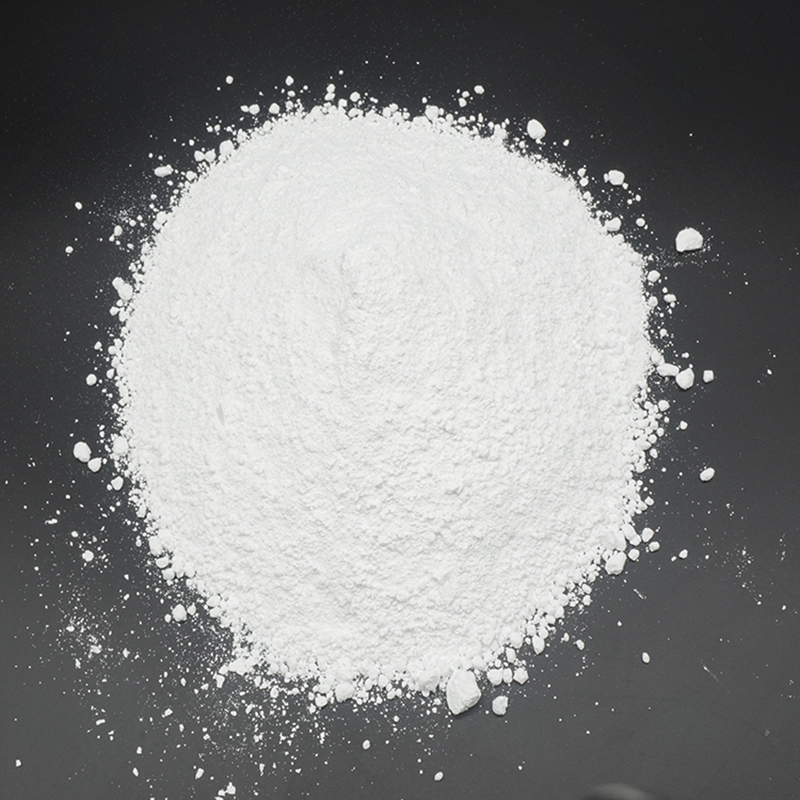
| Ultra-fine matte finish | High-purity White Fused Alumina | 220#–280# | 0.20–0.35 MPa | Boron/Silicon Carbide, 4-6mm |
4. Key Process Parameters and Operating Guidelines
4.1 Pressure Control
A stable blasting pressure of approximately 0.3–0.4 MPa is recommended, with the spray gun maintained at an angle of 45°–60° to the mirror surface to prevent edge chipping.
4.2 Nozzle Selection
Boron Carbide (B₄C) nozzles are strongly recommended for their excellent wear resistance. Use Venturi nozzles for large areas and straight-bore micro nozzles for detailed work.
4.3 Grit Consistency Management
Use an air-classification and abrasive-recovery system to maintain a consistent particle-size distribution and ensure uniform light transmission.
About Us
As a professional abrasive supplier, we are committed to providing White Fused Alumina, Brown Fused Alumina, and customized abrasive grades for glass processing and surface treatment applications.
For samples or a customized abrasive and sandblasting process optimization solution, please contact our technical team.