
Aluminum alloy wheels are widely used in the automotive industry because of their lightweight construction, attractive appearance, and excellent design flexibility. However, achieving a smooth, uniform, high-gloss finish requires careful control of surface preparation, grinding, polishing, and finishing processes.
Whether the goal is to remove machining marks, eliminate minor surface imperfections, improve the appearance of a used wheel, or produce a mirror-like finish on a newly manufactured wheel, selecting the right abrasive materials and polishing equipment is essential.
This guide explains how to polish aluminum alloy wheels, compares common abrasive materials, outlines the main polishing methods, and provides practical recommendations for achieving consistent surface quality in both workshop and industrial production environments.
1. Understanding Aluminum Alloy Wheel Surfaces
Before choosing an abrasive or polishing method, it is important to identify the wheel’s material condition and existing surface finish. Different surface treatments require different processing methods.
1.1 Bare Aluminum Alloy Wheels
Bare aluminum alloy surfaces may show machining marks, light oxidation, scratches, or uneven surface textures. These surfaces can often be improved through progressive sanding, mechanical polishing, or suitable mass-finishing processes.
The main objective is to remove surface defects without excessively removing material or altering the wheel’s original geometry.
1.2 Machined or Diamond-Cut Wheels
Diamond-cut wheels typically feature a precisely machined aluminum surface that creates a bright metallic appearance. Their reflective finish is produced primarily by controlled CNC machining with a diamond cutting tool rather than by conventional abrasive polishing alone.
If the surface is damaged, restoring the original appearance may require specialized wheel resurfacing equipment. Excessive sanding or polishing can alter the machining pattern and remove too much material.
1.3 Painted or Clear-Coated Wheels
Many aluminum alloy wheels have painted, powder-coated, or clear-coated surfaces. In these cases, polishing should be performed on the coating rather than directly on the aluminum substrate, provided the coating remains intact and suitable for polishing.
If the coating is peeling, deeply scratched, or damaged, refinishing may require professional coating removal and reapplication. Abrasive blasting must be carefully controlled to avoid damaging the wheel substrate or compromising its dimensional integrity.
1.4 Chrome-Plated or Specially Finished Wheels
Chrome-plated, anodized, and other specially finished wheels require material-specific treatment. Aggressive abrasives can damage the surface layer and create defects that cannot be corrected through ordinary polishing.
Important: Always identify the wheel’s surface treatment before starting. A process suitable for bare aluminum may be unsuitable for coated, plated, or diamond-cut wheels.
2. The Main Stages of Aluminum Wheel Polishing
Professional aluminum wheel polishing generally involves several stages. The exact sequence depends on the initial surface condition, required finish, wheel design, and production method.
Step 1: Cleaning and Inspection
Begin by removing brake dust, road grime, grease, and other contaminants using a cleaner compatible with the wheel material and coating.
Inspect the wheel for:
- Scratches, corrosion, oxidation, and machining marks
- Coating damage, peeling, or discoloration
- Burrs and sharp edges around machined features
- Previous repairs or signs of structural damage
Cracked, bent, or structurally damaged wheels should be evaluated by a qualified wheel repair specialist. Cosmetic polishing is not a substitute for structural inspection or repair.
Step 2: Surface Preparation and Defect Removal
For bare aluminum alloy, surface preparation may involve sanding, controlled grinding, or mechanical finishing.
The initial abrasive should be selected according to the depth of the defects. Coarser abrasives can remove deeper marks more quickly, but they also leave more pronounced scratches and remove more material.
For this reason, aggressive grinding should be limited to the areas and operations that require it. Avoid unnecessary removal of material from wheel spokes, edges, mounting surfaces, and other precision features.
Step 3: Progressive Abrasive Grinding
After major defects have been addressed, progressively finer abrasives are used to reduce the scratches left by the previous stage.
A typical manual process may use several grades of silicon carbide abrasive paper, moving from a suitable coarse grade toward finer grades such as P400, P600, P800, P1000, P1500, and P2000 or finer, depending on the substrate and finishing requirements.
This is an illustrative sequence rather than a universal specification. The starting grit, intermediate steps, and final sanding grade should be determined by the initial surface condition and the polishing system.
Each stage must remove the scratches from the previous stage before moving to the next. Skipping grades can increase polishing time and leave visible defects in the final finish.
For complex wheel geometries, flexible abrasive materials and suitable hand tools can help reach curved surfaces and narrow recesses. Care is needed to maintain consistent pressure and avoid rounding edges or changing the original profile.
Step 4: Mechanical Polishing
Once the surface has been sufficiently refined, mechanical polishing can improve reflectivity and reduce the visibility of fine scratches.
Common equipment includes:
- Variable-speed polishing machines
- Cotton or sewn-cloth buffing wheels
- Suitable polishing pads and compounds
- Dedicated wheel-polishing machines for production environments
The polishing compound should be compatible with aluminum alloy and the selected buffing system. Coarse compounds may be used for initial polishing, while finer compounds are used for final brightening.
Excessive pressure, high friction, or unsuitable rotational speeds can cause localized overheating, smearing, discoloration, or uneven gloss. Use the polishing equipment manufacturer’s recommended settings and avoid excessive heat buildup.
Step 5: Final Cleaning and Surface Protection
After polishing, remove polishing residues and inspect the entire wheel under consistent lighting.
Depending on the intended application, the final surface may require a compatible clear coat, protective coating, or other finishing treatment. Bare polished aluminum can oxidize or lose its appearance during service, so the appropriate protection system should be selected according to the required durability and maintenance conditions.
3. Which Abrasive Materials Are Suitable for Aluminum Wheel Polishing?
Different abrasive materials serve different purposes. The most appropriate choice depends on whether the operation involves defect removal, surface preparation, precision grinding, mass finishing, or final polishing.
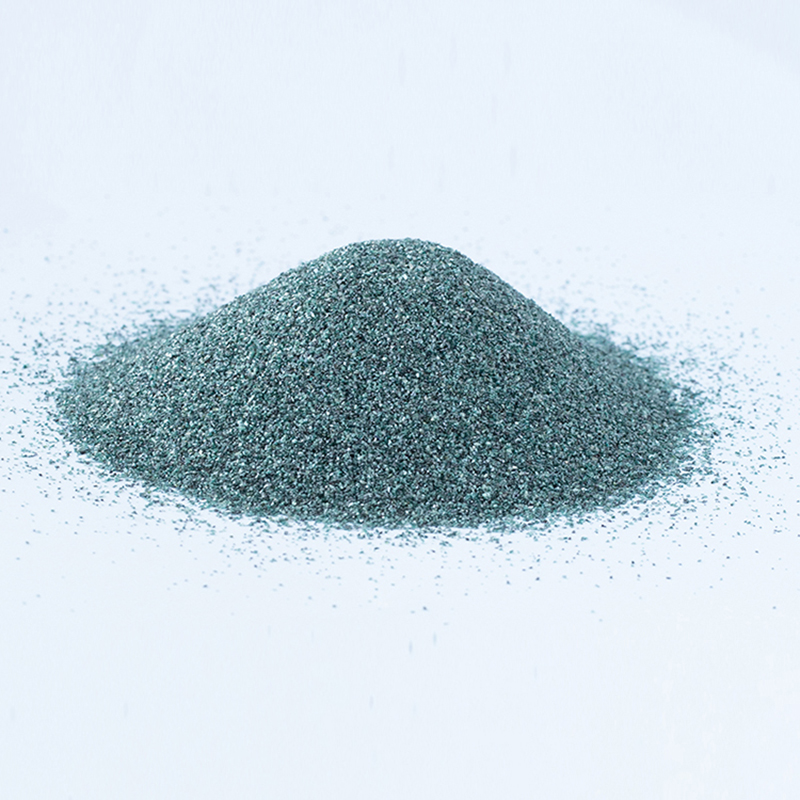
3.1 Silicon Carbide (SiC)
Silicon carbide is a hard abrasive widely used in sanding, grinding, and finishing applications.
Black silicon carbide is commonly used in abrasive papers, grinding products, and selected finishing processes. Green silicon carbide is also used in precision grinding and specialized abrasive applications.
For aluminum wheel finishing, silicon carbide abrasive paper is often useful for progressive manual sanding because it is available in a broad range of grit sizes and can be used in suitable wet or dry sanding systems.
Loose silicon carbide grains may also be used in engineered abrasive processes, but they should not automatically be treated as a substitute for abrasive paper or a polishing compound.
Aluminum is relatively soft and can be prone to loading, smearing, and embedded abrasive particles. Therefore, abrasive selection, lubrication, cleaning, and process control are important.
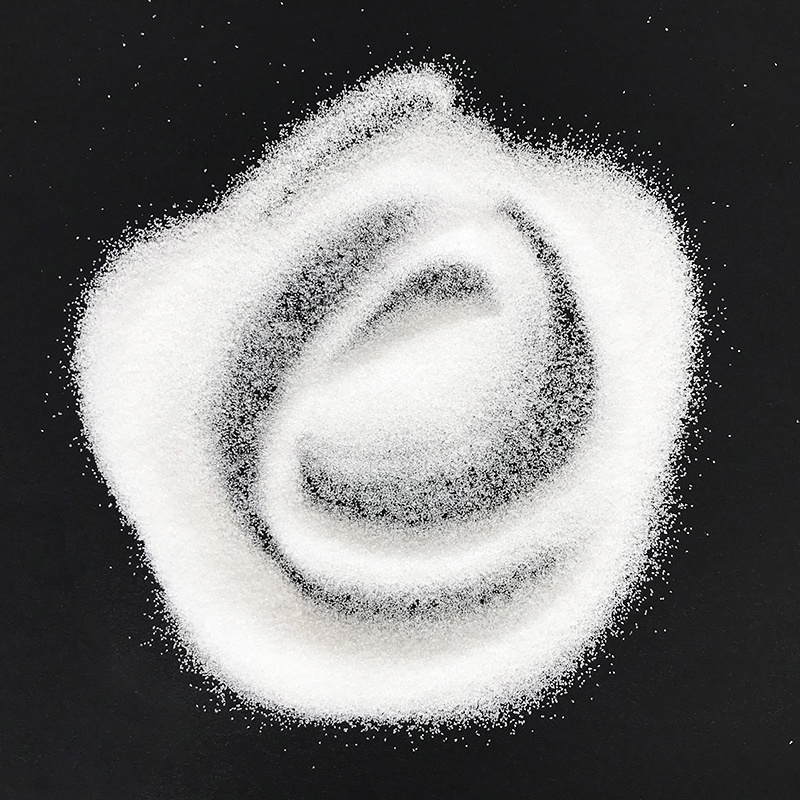
3.2 White Fused Alumina (WFA)
White fused alumina is a high-purity aluminum oxide abrasive known for its hardness and sharp cutting characteristics. It is widely used in abrasive blasting, grinding, and surface preparation.
Potential applications in wheel manufacturing or refinishing include selected surface-cleaning and preparation operations where a controlled abrasive impact is appropriate.
However, white fused alumina is not normally the primary material for achieving the final mirror finish on aluminum wheels. Conventional abrasive blasting with WFA generally produces a matte or textured surface rather than a polished metallic appearance.
If WFA is used for surface preparation, the grit size, blasting pressure, nozzle distance, exposure time, and substrate condition must be carefully controlled. The process should be validated on a test piece before treating a finished wheel.
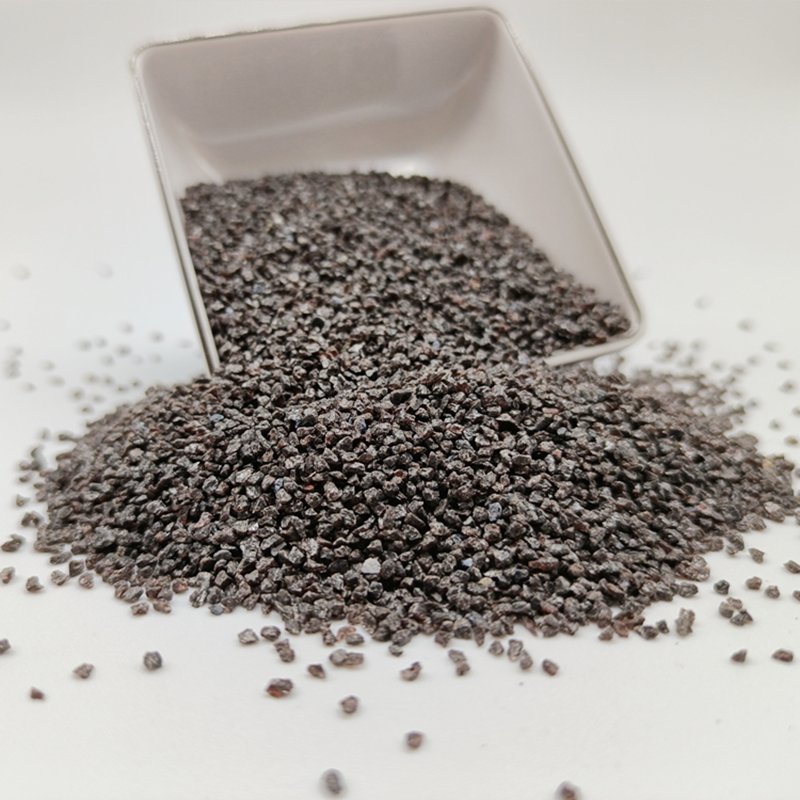
3.3 Brown Fused Alumina (BFA)
Brown fused alumina is a tough, durable aluminum oxide abrasive commonly used in grinding wheels, abrasive blasting, and heavy-duty surface preparation.
Its toughness and cost-effectiveness make it suitable for many industrial abrasive applications. However, for aluminum wheel finishing, the suitability of BFA depends on the process and the desired surface condition.
Coarse abrasive blasting can produce a roughened surface and may create defects that require additional finishing. It is therefore not a direct replacement for fine sanding or polishing compounds when a high-gloss finish is required.
3.4 Aluminum Oxide Polishing Abrasives
Fine aluminum oxide abrasives can be incorporated into polishing compounds, abrasive papers, and other finishing products.
Their performance depends on particle size, particle shape, abrasive concentration, binder or carrier system, and the properties of the aluminum alloy being processed.
Fine alumina can support controlled finishing operations, but particle size alone does not determine the final gloss. The polishing pad, compound formulation, pressure, speed, and surface preparation are equally important.
3.5 Polishing Compounds and Buffing Media
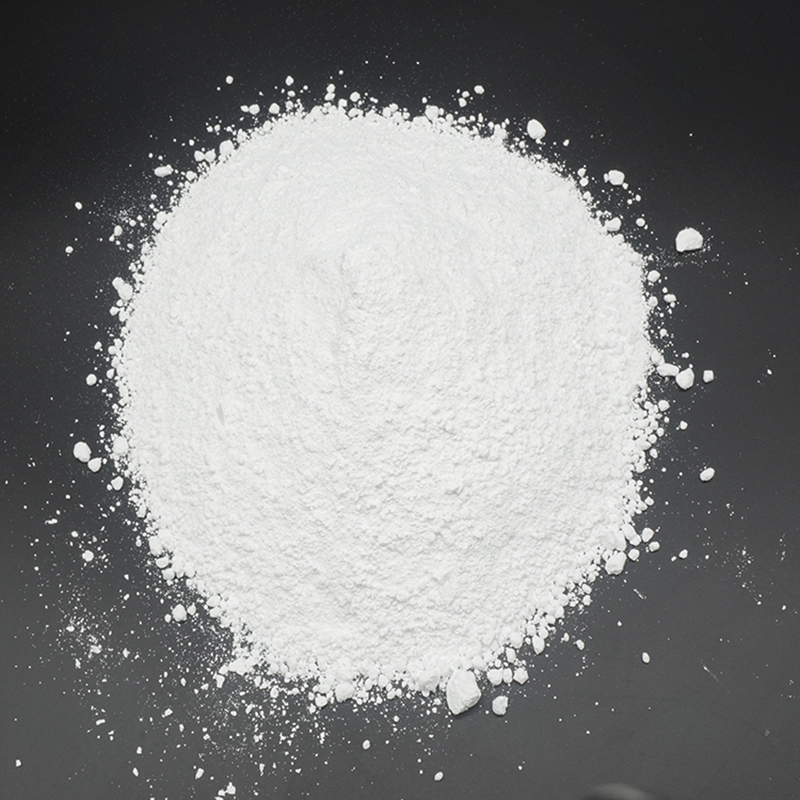
For final brightening, purpose-formulated aluminum polishing compounds are often more suitable than loose abrasive grains.
These compounds may contain fine abrasive particles in a carrier designed for use with cloth wheels, polishing pads, or automated equipment. The correct compound depends on the required finish and the polishing system.
Cotton and other suitable buffing media provide the mechanical contact needed to distribute the compound and refine the surface. Compound selection and buffing-wheel condition should be evaluated together.
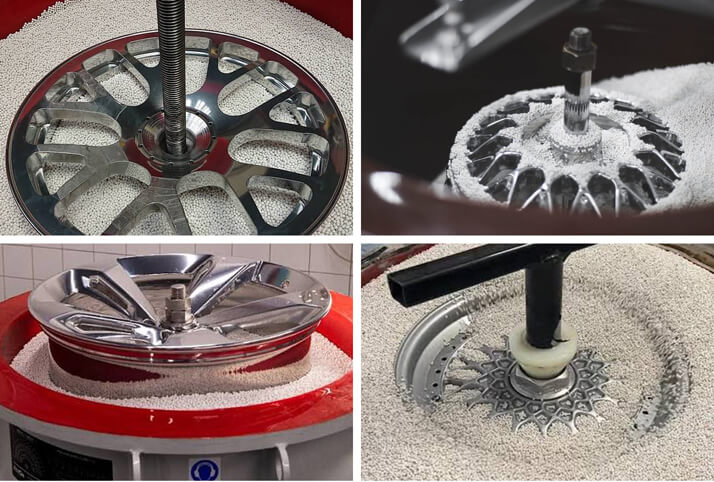
3.6 Plastic and Ceramic Finishing Media
Plastic and ceramic media are used in vibratory finishing, centrifugal finishing, and other mass-finishing processes.
Plastic media may be suitable for gentler deburring and surface finishing of aluminum components. Ceramic media generally provide more aggressive cutting action and may be appropriate for selected applications requiring greater material removal.
These media are not interchangeable. Ceramic media can be too aggressive for delicate aluminum surfaces, while plastic media may not provide sufficient cutting action for certain defects.
For alloy wheels, the process must account for the large surface area, complex spoke geometry, recessed features, and the risk of media marks or uneven finishing.
4. How to Select the Right Abrasive Grit Size
Abrasive grit size directly influences cutting performance, surface roughness, material removal, and the amount of work required in subsequent polishing stages.
| Process stage | Typical abrasive option | Main objective |
|---|---|---|
| Initial defect removal | Suitable coarse abrasive paper or controlled grinding media | Remove selected defects |
| Intermediate sanding | Medium-grit silicon carbide paper | Refine the surface |
| Fine sanding | Fine silicon carbide paper, such as P1000–P2000 where appropriate | Reduce visible scratches |
| Pre-polishing | Fine abrasive compound or suitable finishing media | Prepare for final brightening |
| Final polishing | Fine aluminum-compatible polishing compound and buffing wheel | Improve reflectivity and gloss |
The grit sequence should be adapted to the initial surface condition. For example, a lightly scratched surface may require only fine sanding and polishing, while a heavily damaged surface may need additional preparation.
It is also important to distinguish between abrasive grit standards. FEPA P-grit designations for coated abrasives, bonded-abrasive grain designations, and mesh-based classifications are not directly interchangeable in every application.
For production work, confirm the applicable grading standard with the abrasive supplier and equipment manufacturer.
5. Manual Polishing vs. Vibratory Finishing vs. Automated Polishing
The choice of polishing method depends on production volume, wheel geometry, surface requirements, and budget.
Manual Polishing
Manual polishing is commonly used for repair work, customized wheels, and localized finishing.
Advantages include flexibility and relatively low equipment investment. Operators can concentrate on specific areas and adjust the process according to the surface condition.
However, manual polishing is labor-intensive and may produce inconsistent results if pressure, speed, and polishing time vary between operators.
Vibratory or Mass Finishing
Vibratory finishing can be useful for certain aluminum components requiring deburring, edge finishing, or surface refinement.
Its suitability for complete alloy wheels depends on the machine capacity, media size, fixture design, and wheel geometry. Deep recesses and narrow spaces may receive uneven treatment, and contact with the media can create unwanted marks.
A full-wheel trial is recommended before establishing a production process.
Automated Mechanical Polishing
Automated polishing systems can improve process consistency and throughput when handling repeatable wheel designs.
However, fixtures, tool paths, contact pressure, polishing speed, and compound delivery must be optimized for the wheel geometry. Complex spokes and recessed areas may require specialized tooling or multiple processing steps.
CNC Diamond-Cut Machining
For diamond-cut wheels, CNC machining with a diamond cutting tool is often the primary method used to create a precise, bright metallic surface.
This process is different from conventional abrasive polishing. It requires appropriate equipment, accurate fixturing, controlled machining parameters, and sufficient remaining material.
Where a wheel has a damaged diamond-cut surface, professional assessment is necessary to determine whether refinishing is appropriate.
6. Key Process Parameters That Affect Polishing Quality
A successful aluminum wheel finishing process depends on more than abrasive selection.
Abrasive condition: Worn, contaminated, or unsuitable abrasives can reduce cutting efficiency and create inconsistent scratches.
Contact pressure: Excessive pressure can generate heat, deform delicate features, and produce uneven material removal.
Rotational speed: The correct speed depends on the polishing machine, wheel diameter, compound, and buffing material. Follow equipment specifications rather than applying a universal speed.
Heat management: Aluminum conducts heat well, but localized friction can still cause overheating, compound smearing, and surface discoloration.
Cleaning between stages: Residual coarse abrasive particles can introduce deep scratches during fine polishing. Clean the surface and tools between stages.
Geometry control: Wheel edges, spoke profiles, mounting surfaces, and other precision features must retain their intended dimensions and shape.
Repeatability: For industrial production, document abrasive grades, equipment settings, cycle times, and inspection criteria to improve batch-to-batch consistency.
7. Common Problems in Aluminum Alloy Wheel Polishing
Problem 1: The Surface Remains Scratched After Polishing
This often occurs when the previous sanding stage has not fully removed deeper scratches, or when an abrasive grade has been skipped.
Recommended action: Return to the appropriate sanding stage, remove the existing defects, and proceed through the remaining grades in sequence. Clean the wheel and polishing tools before changing to a finer abrasive.
Problem 2: The Finish Looks Cloudy Instead of Mirror-Like
Possible causes include incomplete surface refinement, unsuitable polishing compounds, contaminated buffing wheels, or inconsistent contact pressure.
Recommended action: Review the final sanding stage and polishing system. Use a compound designed for aluminum and verify that the surface is sufficiently smooth before final buffing.
Problem 3: The Aluminum Surface Shows Smearing or Dark Residue
Aluminum can load abrasive surfaces, and polishing compounds may leave residue when used under unsuitable conditions.
Recommended action: Check abrasive suitability, tool cleanliness, compound application, and operating temperature. Use compatible cleaning methods and avoid excessive pressure.
Problem 4: Recessed Areas and Spokes Have Uneven Gloss
Complex wheel geometry can make uniform contact difficult, especially with manual polishing or mass-finishing equipment.
Recommended action: Evaluate smaller polishing tools, suitable flexible abrasives, or dedicated tooling. Inspect the entire wheel under consistent lighting to identify areas requiring additional finishing.
Problem 5: The Surface Looks Bright but Corrodes Quickly
Bare polished aluminum can develop an oxide layer and may be affected by road salts, moisture, and cleaning chemicals.
Recommended action: Select a compatible protective coating or finish and establish appropriate cleaning and maintenance procedures.
8. Quality Inspection After Polishing
A professional finishing process should include defined inspection criteria.
Important quality checks include:
- Visual appearance: Check for scratches, haze, discoloration, compound residue, and uneven gloss.
- Surface roughness: Use an appropriate roughness measurement method when numerical surface requirements are specified.
- Gloss consistency: Measure gloss where required, using a consistent measurement method and suitable reference standards.
- Dimensional integrity: Verify that critical dimensions, mounting surfaces, and original profiles have not been compromised.
- Coating condition: For coated wheels, inspect adhesion, coverage, and visible defects according to the applicable coating specification.
- Cleanliness: Ensure that abrasive residues and polishing compounds have been removed from the surface and recessed areas.
For repeat production, a documented inspection procedure and representative reference samples can help maintain consistent results.
9. Safety Considerations When Polishing Alloy Wheels
Wheel polishing and abrasive finishing involve rotating machinery, airborne particles, noise, and potentially hazardous residues.
Follow the equipment manufacturer’s operating instructions and applicable workplace safety requirements.
Key precautions include:
- Wear appropriate eye protection and other task-specific personal protective equipment.
- Use suitable local exhaust ventilation or dust extraction for sanding, grinding, and abrasive blasting.
- Select respiratory protection based on the risk assessment and applicable regulations.
- Keep hands, clothing, and loose objects away from rotating buffing wheels and moving equipment.
- Secure the workpiece correctly and inspect polishing tools before use.
- Follow the polishing compound safety data sheet and avoid incompatible cleaning chemicals.
- Do not use ordinary abrasive blasting equipment on a finished wheel without confirming process suitability and protecting critical surfaces.
Aluminum dust can present a combustible-dust hazard under certain conditions. Dust collection, housekeeping, and fire prevention must be designed for the material and process involved.
10. How to Choose an Abrasive Supplier for Aluminum Wheel Finishing
When sourcing abrasives for wheel polishing or surface preparation, buyers should evaluate the supplier’s technical capability rather than selecting a product by price alone.
Important considerations include:
Consistent particle-size distribution: Stable grading helps maintain predictable cutting behavior and surface quality.
Product suitability: The abrasive must match the operation, whether it is blasting, grinding, sanding, deburring, or precision finishing.
Technical documentation: Product specifications, applicable grading standards, and relevant quality documents help buyers compare materials accurately.
Sample testing: Testing on representative aluminum alloy parts helps verify surface appearance, processing time, abrasive consumption, and compatibility with the equipment.
Supply stability: Consistent product quality and dependable delivery are important for workshops and industrial production lines.
At XINLI Abrasives, we supply abrasive materials for a range of industrial grinding, blasting, and surface preparation applications, including white fused alumina, brown fused alumina, and silicon carbide. We can discuss particle-size requirements and provide suitable samples for testing to help customers evaluate the abrasive before placing a larger order.
The correct abrasive should always be selected according to the actual finishing process and the required surface result.
11. Frequently Asked Questions
Q1: Can white fused alumina be used to polish aluminum alloy wheels?
White fused alumina is primarily used for grinding, abrasive blasting, and surface preparation. It may be suitable for selected preparation operations, but conventional WFA blasting generally produces a matte or textured surface rather than a mirror finish. Fine polishing compounds and appropriate buffing systems are typically more suitable for final brightening.
Q2: Is silicon carbide suitable for aluminum wheel polishing?
Yes. Silicon carbide abrasive paper is commonly used for progressive sanding and surface refinement on suitable bare aluminum surfaces. The correct grit sequence depends on the initial condition and target finish. Loose SiC grains should be used only in a process designed for that abrasive form.
Q3: Can abrasive blasting produce a mirror finish on aluminum wheels?
Conventional abrasive blasting generally creates a matte or textured surface. It is usually used for cleaning or preparation rather than as the final mirror-polishing step. A high-gloss finish normally requires progressive surface refinement and mechanical polishing, or specialized machining for diamond-cut wheels.
Q4: What is the best abrasive grit for aluminum wheel polishing?
There is no single best grit for every wheel. Coarser abrasives may be needed to remove defects, while progressively finer grades reduce scratches before final polishing. The starting grade should be selected according to the surface condition, material, and finishing requirements.
Q5: Do painted aluminum wheels need the same polishing process as bare aluminum wheels?
No. Painted or clear-coated wheels require a process compatible with the coating. Aggressive sanding or blasting can remove or damage the finish. If the coating is peeling or damaged, professional refinishing may be necessary before polishing or applying a new coating.
Q6: How can I achieve a consistent mirror finish on aluminum wheels?
Start with the correct surface preparation, remove scratches progressively, clean between abrasive stages, and use a compatible aluminum polishing compound and buffing system. Control pressure, speed, and heat, then inspect the surface under consistent lighting. For diamond-cut wheels, specialized CNC machining may be required.
Conclusion
Polishing aluminum alloy wheels requires a coordinated approach to surface preparation, abrasive selection, progressive grinding, mechanical polishing, and final protection. Silicon carbide abrasives are useful for many sanding and refinement operations, while white fused alumina and brown fused alumina are more commonly associated with selected grinding and surface preparation processes. Fine polishing compounds and suitable buffing systems are generally more appropriate for achieving a high-gloss finish.
The most effective process depends on the wheel’s alloy, existing coating, surface condition, geometry, production volume, and final appearance requirements. By matching the abrasive material to the correct processing stage and validating the process through sample testing, manufacturers and repair specialists can improve surface consistency, reduce rework, and achieve more reliable finishing results.
Looking for suitable abrasives for aluminum surface preparation or industrial finishing? Contact XINLI Abrasives to discuss your application, particle-size requirements, and sample testing options.