
A Critical Engineering Material for High-Performance Braking, Wear Resistance, and Precision Manufacturing
Meta Description
Discover how black silicon carbide enhances carbon ceramic brake systems through microstructure control, friction stability, thermal resistance, and precision machining. A key material for advanced automotive braking technology.
Carbon ceramic brake systems have become the preferred solution for high-performance vehicles, racing platforms, premium electric cars, and aerospace applications where lightweight construction and extreme thermal reliability are essential. Compared with traditional cast iron brake discs, carbon ceramic composites offer significant advantages, including lower weight, higher operating temperatures, longer service life, and more consistent braking behavior under repeated stress. These benefits, however, are not achieved by carbon fiber alone. The true functional backbone of carbon ceramic brakes lies in the formation of a silicon carbide (SiC) ceramic phase that reinforces the composite structure and stabilizes friction performance. In modern manufacturing, black silicon carbide has proven to be one of the most practical and efficient SiC materials for supporting this process. Thanks to its high hardness, thermal stability, chemical inertness, and cost effectiveness, black SiC is widely applied from raw material preparation to final machining, making it a key enabler of advanced carbon ceramic brake technology.
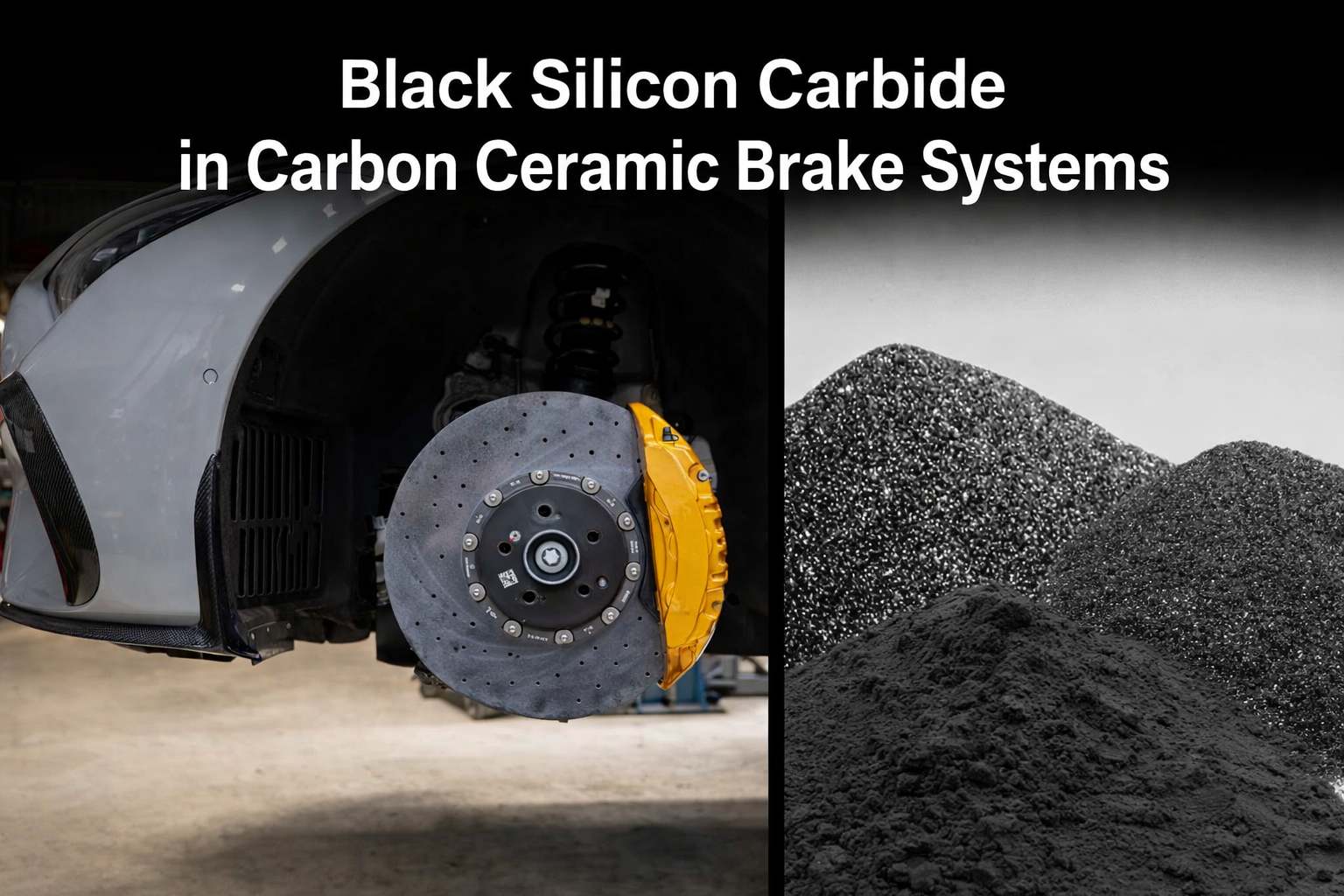
During the material processing stage, black silicon carbide plays an essential role in controlling the reaction bonding or liquid silicon infiltration process used to produce carbon ceramic brake discs. In this stage, molten silicon penetrates a porous carbon preform and reacts to form silicon carbide, creating a dense C/SiC composite. The uniformity of this reaction directly affects strength, durability, and long-term reliability. Black SiC particles can act as nucleation points that promote consistent SiC formation while reducing irregular growth, internal voids, or structural defects. By helping regulate phase distribution and refine microstructure, these particles improve density and mechanical integrity, allowing the final brake disc to withstand extreme loads and thermal cycling. This controlled formation also enhances compressive strength, flexural strength, and fatigue resistance, ensuring that the brake components maintain stable performance even under aggressive, repeated braking conditions such as those experienced in racing or high-speed driving environments.
From a performance perspective, the silicon carbide phase created with the assistance of black SiC directly determines many of the critical functional properties of carbon ceramic brake systems. Silicon carbide’s exceptional hardness provides outstanding wear resistance, significantly reducing material loss at the friction interface between the disc and brake pad. At the same time, its high thermal conductivity enables rapid heat dissipation, preventing overheating and minimizing the risk of brake fade. The low thermal expansion coefficient of SiC also improves thermal shock resistance, allowing the brake disc to tolerate sudden temperature changes from ambient conditions to several hundred or even over one thousand degrees Celsius without cracking or deformation. These combined characteristics ensure a stable friction coefficient, smoother braking response, lower noise and vibration, and a much longer service life compared with conventional metallic brakes. As a result, black silicon carbide contributes not only to structural reinforcement but also to the overall safety and consistency of braking performance.
Beyond its contribution to composite formation and functional performance, black silicon carbide is equally important in the machining and finishing stages of carbon ceramic components. Once sintered and bonded, C/SiC brake discs become extremely hard and difficult to process using ordinary tools. Traditional abrasives often show rapid wear or low efficiency, leading to high production costs and poor surface quality. Black SiC abrasives, however, offer sharp cutting edges, strong grinding capability, and excellent durability, making them ideal for precision grinding, shaping, edge trimming, and surface finishing operations. These abrasives allow manufacturers to achieve tight dimensional tolerances, smooth surface roughness, and accurate flatness, all of which are critical for balanced rotation and safe braking. Because of its favorable balance between performance and cost, black silicon carbide has become one of the most widely used abrasive materials for carbon ceramic brake machining across both large-scale industrial production and specialized high-end manufacturing.
Black silicon carbide is also widely used in research, development, and quality testing of advanced braking materials. Different grit sizes and powder grades enable engineers to simulate real-world wear conditions, evaluate friction stability, and study the interaction between ceramic surfaces and brake pads. In laboratory environments, black SiC helps assess abrasion resistance, optimize formulations, and refine composite structures to achieve better durability and thermal behavior. Its versatility makes it suitable for prototype development, small-batch experimentation, and continuous process improvement. This means that black silicon carbide serves not only as a manufacturing consumable but also as a strategic tool for innovation, helping researchers push the limits of carbon ceramic brake technology and develop next-generation materials for even more demanding applications.
As the automotive and mobility industries continue moving toward lightweight design, higher efficiency, and enhanced reliability, the adoption of carbon ceramic brake systems is expected to expand beyond supercars into electric vehicles, autonomous platforms, motorsports, and aerospace equipment. This growing demand further highlights the importance of high-quality silicon carbide materials that can deliver consistent performance while maintaining economic feasibility. With its excellent combination of hardness, thermal stability, processing efficiency, and affordability, black silicon carbide remains one of the most practical and scalable choices for manufacturers worldwide. From material engineering and reaction bonding to precision machining and performance testing, black SiC supports every step of the production chain, making it far more than a simple abrasive or additive. It is, in essence, a foundational engineering material that continues to drive the evolution of safer, lighter, and more durable carbon ceramic brake systems.