1. The Role and Application of Acid Washing
Acid washing is crucial for removing metallic impurities and some metal oxides from silicon carbide. The core principle is to react the impurities with an acidic solution (commonly concentrated sulfuric acid or hydrochloric acid), converting insoluble metallic impurities into soluble compounds for separation. The impurities removed often originate from smelting, crushing, and other processing processes, such as iron impurities introduced by ball mill wear and calcium and magnesium oxides carried in the raw materials. For example, silicon carbide micropowder used in semiconductor wire cutting can effectively remove metallic impurities such as Cu and Fe by acid washing with concentrated sulfuric acid, ensuring the cleanliness of the micropowder meets the requirements of high-end processing.
Acid pickling can also improve the surface properties of silicon carbide: making the surface cleaner and rougher, enhancing the bonding strength with the binder, and extending the service life of the abrasive; removing the surface oxide layer, restoring its inherent properties such as hardness and wear resistance; reducing the content of magnetic materials, reducing iron spot defects, improving the first-pass yield rate, and reducing production costs.
2. The Role and Application of Alkaline Washing
Alkaline washing mainly removes free silicon, silica, and some alumina and graphite impurities. Soluble silicates are formed by the reaction of sodium hydroxide solution with the impurities, followed by water washing and separation. Free silicon and silica reduce the purity and hardness of silicon carbide, especially affecting the quality of high-end products. For example, during silicon carbide granulation, alkaline washing of 150# coarse silicon carbide can effectively remove surface free silicon, silica, and some graphite, improving product purity.
3. Synergistic Effect of Combined Acid-Alkali Washing
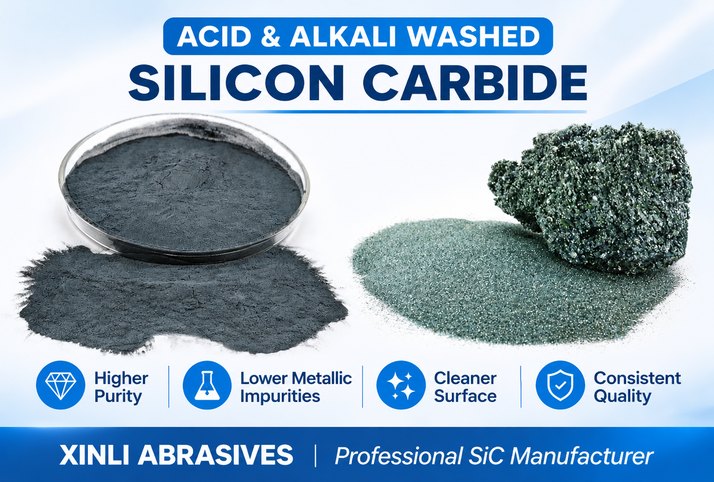
The combined acid-alkali washing process is far superior to single acid washing, alkali washing, or water washing: single water washing can only remove graphite and dust; silicon carbide without washing treatment is of poor quality and cannot meet high-end requirements. Combined treatment can remove various impurities, significantly improving purity and surface cleanliness, enhancing chemical composition stability, greatly increasing first-pass yield and finished product yield, and reducing iron sand production. Simultaneously, this process can relax the grading standards for smelting crystal blocks and reduce electricity consumption. Although it slightly increases production costs, it can consistently produce high-quality products and enhance market competitiveness.
4. Adjustment and Optimization of Actual Production Process
In actual production, the acid-alkali washing process parameters can be adjusted according to silicon carbide particle size, impurity composition, and application requirements: Micronized silicon carbide for semiconductor wire cutting requires multiple fine treatments such as decarburization and degreasing, with strict control of acid and alkali concentration, temperature, and time; coarse-grained silicon carbide can be treated using a stainless steel conical tank with stirring to improve efficiency and uniformity. As the industry raises its quality requirements, acid and alkali washing processes are constantly being optimized. By improving equipment and optimizing parameters, impurities can be removed efficiently and energy consumption can be reduced, further highlighting its important role in improving the quality of silicon carbide.